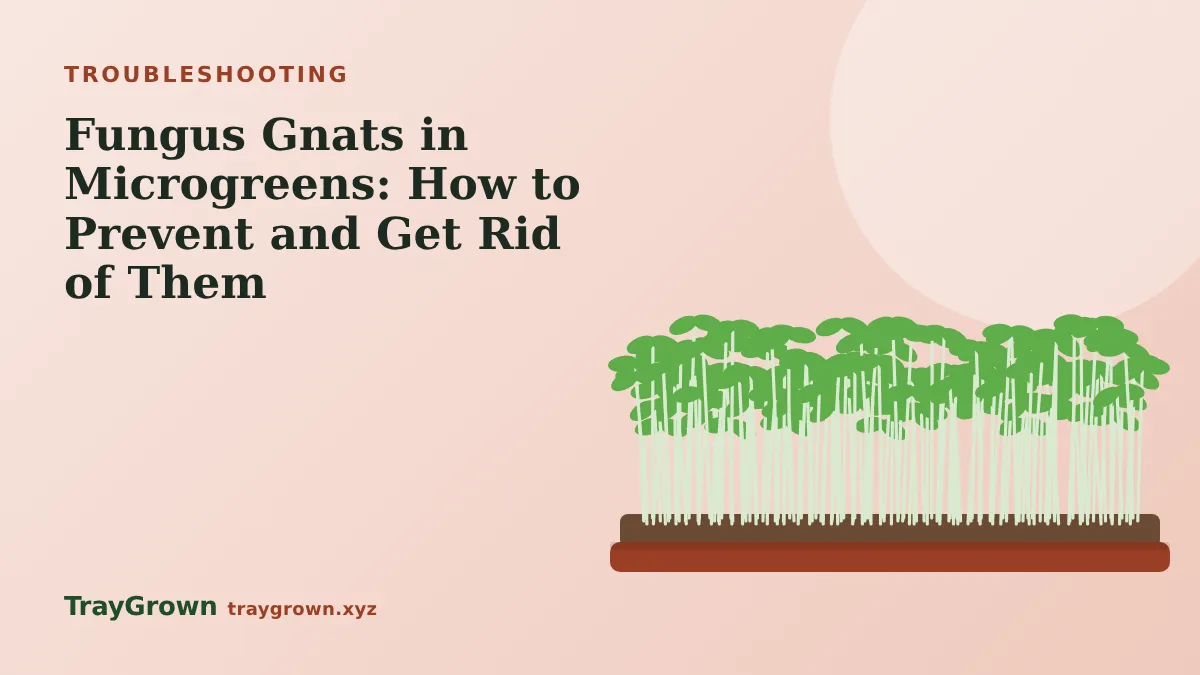
If small black flies drift up from your microgreen trays when you water, you have fungus gnats. They’re a nuisance rather than a disaster — adult gnats don’t bite and rarely damage microgreens directly — but their larvae live in damp growing medium and can feed on roots, and a big population is unpleasant in a kitchen.
The key to controlling them is understanding their short life cycle and making your trays a poor place to breed.
How to recognize fungus gnats
- Tiny (about ⅛ inch / 2–3 mm), dark grey or black flies with long legs and antennae.
- Weak, erratic fliers that hover around trays and potting mix.
- They often run across the surface of the medium.
- Larvae are tiny, translucent white worms with shiny black heads, found in the top inch of damp medium.
Fruit flies, by contrast, are tan with red eyes and hang around fruit bowls and bins rather than soil.
The fungus gnat life cycle
| Stage | Where | How long (at room temperature) |
|---|---|---|
| Eggs | Laid on moist medium | About 3–4 days |
| Larvae | Top 1–2 inches of damp medium | About 1–2 weeks |
| Pupae | In the medium | About 3–5 days |
| Adults | Flying around trays | About 1 week, laying up to a few hundred eggs |
A full cycle takes roughly 3–4 weeks. Because a microgreens tray only lasts 1–3 weeks, most infestations come from outside the tray — usually an open bag of potting mix, house plants, or compost nearby.
Where fungus gnats come from
- Bagged potting mix — larvae or eggs can already be in the bag, especially if it was stored open or outdoors.
- House plants in the same room with constantly moist soil.
- Used trays and leftover medium left sitting damp.
- Indoor compost bins and worm farms.
Prevention: the most effective steps
Store growing medium sealed
Keep potting mix and coco coir in a sealed bin or tied bag. An open bag of damp soil is an ideal nursery. Compressed coco coir bricks are less likely to carry gnats than loose potting mix.
Let the surface dry
Females lay eggs in moist organic matter. Bottom watering keeps the top of the medium drier than top watering, which makes it less attractive. See how to water microgreens.
Don’t leave old trays lying around
Compost spent trays promptly in an outdoor bin, and wash and dry trays straight away.
Consider a soil-free medium
Hemp, jute or fibre mats contain far less organic matter for larvae to feed on. They’re a good option if gnats are a recurring problem. Compare media in our growing medium guide, or read about growing without soil.
Check your house plants
If nearby house plants have gnats, treat them at the same time. Let their soil dry between waterings.
Getting rid of fungus gnats
Yellow sticky traps
Adult gnats are attracted to yellow. Place small sticky traps around (not inside) the trays. They catch adults before they lay eggs and show you how big the problem is. They don’t solve an infestation alone, but they’re an important part of breaking the cycle.
BTI (Bacillus thuringiensis israelensis)
BTI is a naturally occurring soil bacterium that kills fly larvae, including fungus gnat larvae, and is widely used in organic growing. It’s sold as granules or “dunks” for mosquito control. Soak the product in water as directed on the label and use that water for the potting mix in your growing area, or for house plants. Always read and follow the label, and check that the product is permitted for use on edible crops where you live.
Beneficial nematodes
Steinernema feltiae nematodes are microscopic organisms sold to control fungus gnat larvae in soil. They’re more useful for a large grow room or house plants than for a single microgreens shelf.
Start fresh
Sometimes the fastest fix is to compost every tray, seal or replace the medium, clean the shelf, and restart with sticky traps in place. Because microgreens are a quick crop, you lose only a week or two.
What not to use on microgreens
Avoid household insect sprays and any pesticide not labeled for edible plants. Microgreens are eaten within days, so there’s no time for residues to break down. Prevention, sticky traps and a dry surface are almost always enough.
Frequently asked questions
Are fungus gnats harmful to eat if they land on microgreens?
They’re a hygiene nuisance rather than a known health risk, but you should wash microgreens that had insects on them and fix the source.
Why do I have gnats even with new soil?
The bag may already have contained eggs or larvae, or gnats are coming from house plants nearby.
Does a fan help with fungus gnats?
Yes. Airflow helps the surface dry and makes it harder for the weak-flying adults to settle on trays.